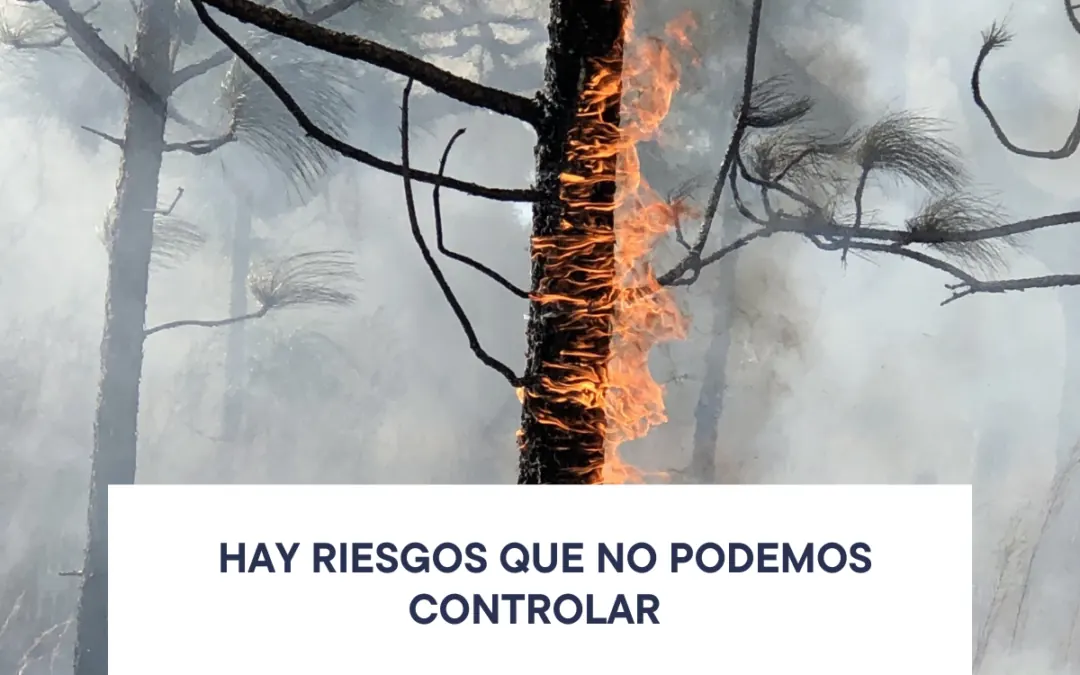
Every summer, the same images appear: smoke on the horizon, hectares burnt to the ground, families evacuated. And every summer, we repeat the same phrase, almost like a ritual: ‘there are risks we cannot control’. That is true. But at Coyfer, we have spent years seeing something that almost nobody says out loud: what really makes the difference is not the fire itself, but the small print of what you took out before it started to burn. And that is exactly where our work comes in.
The risk has changed, but many policies have not
The ‘wildfire season’ is no longer limited to July and August: the risk window has extended into months that used to be considered safe, and fire spreads differently from how it did a decade ago. This is not a technical nuance. It is the reason why many policies taken out five or ten years ago no longer reflect today's reality, because they were calculated on outdated risk maps. It is precisely this constant updating (of each client's real risk compared with the risk on which the policy was signed) that we at Coyfer consider an inseparable part of our work, not an optional extra.
What is rarely explained
There are several things that are rarely explained clearly when you take out insurance, and that only come to light on the worst possible day, once the loss has already happened. They are precisely the points we review with every client at Coyfer before they become a problem.
The first is that many home insurance or agricultural and forestry policies include specific fire exclusions or limits that depend on the location, the distance to woodland or the use of the land. If nobody has reviewed that clause with you, you cannot know whether it genuinely protects you or only appears to.
The second is that the sum insured is almost never updated in line with rising rebuilding and replacement costs. After a loss, it is common to discover that the amount insured covers considerably less than what it actually costs to rebuild what has been lost. That is why, at Coyfer, we insist on reviewing sums insured regularly, not only when the policy is taken out.
The third is that the losses caused by a fire are rarely limited to material damage. A business, an industrial building or a farm may be brought to a standstill for weeks or months. Business interruption or loss of profits cover is often the great omission in standard policies, precisely because nobody asked about it in time.
The fourth is that a fire does not end when the flames are put out. Other costs follow that are rarely taken into account when taking out a policy: removing debris and burnt remains, cleaning up smoke damage (which can affect parts of the property the fire never even reached) and, in many cases, temporary accommodation while the home or business premises are uninhabitable. Not all policies cover these items in the same way, and this is exactly the kind of detail we review clause by clause when preparing each proposal.
The fifth particularly affects industrial businesses: a fire can give rise to environmental liability. The water used by firefighters to put it out can carry the remains of burnt materials or other substances into the soil, rivers or sewers. This can lead to very high decontamination costs, and many companies are unaware that these costs are not always covered by their standard policy. It is a risk we at Coyfer always bear in mind when designing the cover for any industrial building or activity.
And the sixth, the one that is least often mentioned: many claim rejections are not the result of bad faith on the part of the insurer, but of a policy that was never matched to the client's actual activity, risk or assets. In other words, the problem does not always lie in the day of the loss. It lies in the day the policy was taken out, and in whether anyone has taken the trouble to review it since.
Our job is the review, not just the policy
At Coyfer, we see insurance broking as a commitment, not a one-off transaction. Our job is not to place a policy and disappear until renewal. It is to understand each situation in detail: where the risk is located, what has changed in the client's business or assets since the last review, and which scenarios are more likely today than they were a few years ago.
That means reviewing proactively, not only when the client asks. It means speaking up when cover has fallen short, even if that involves an uncomfortable conversation before any good news. And it means building every proposal to measure, without generic templates, because the risk facing an isolated house next to a forest has nothing in common with that of a warehouse on an industrial estate.
Peace of mind is not bought, it is prepared
An insurance policy is not a piece of paper to be filed away. It is the answer you will need on the day everything else fails. That answer is built months in advance: reviewing sums insured, updating cover and anticipating scenarios that nobody wants but that are increasingly likely.
If it has been a while since you reviewed your policy with the real risk of fire in mind, now is a good time to do so. Not when summer is already well under way, but now, while there is still time to adjust whatever is needed. At Coyfer, this review, tailored to each client, is simply the way we work.